Trainings
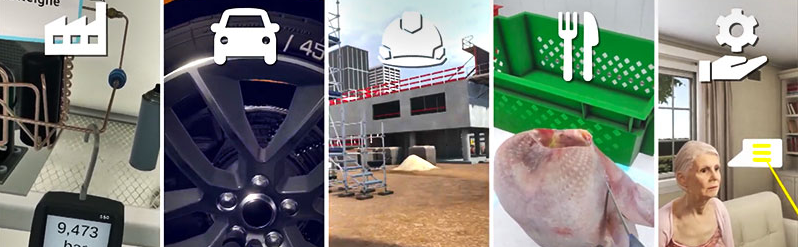 Source: Learn Virtual Europe
Simulation based trainings cover a broad range of skills. Psychomotor skills like operating or maneuvering, process skills such as knowing and acting appropriately in a technological process are the the main fields. There are number of scenarios in the AR/VR field.
Psychomotor skills
Cutting, joining and coating professes are the highly demanded vocational skills for various manufacturing and construction industries. Trainees need to undergo many practical sessions to become skilful workers. However, conventional training is very costly in terms of material, time, and infrastructure.
The trainings simulators focus on psychomotor development first along with focusing abilities and motivation. There is little doubt in their effectiveness.

Other professional areas such as tower cranes, truck driving, forklifting, agricultural and forestry machine operating psychomotor skills training emerge in the last few years. Most of the simulation trainings however are used in entry-level education but there are some examples of refreshing trainings where experienced professionals are tested with simulators to renew their licenses. The results of trainings for experienced professionals are good after breaking through their skepticism.
Example: welding
In welding simulators are to support the welding training for the vocational training world. The simulation seen in the picture above using a curious cutting edge technology and electro-magnetic real time motion tracking systems. Th simulator allows the user to be immersed by the high quality simulation into the virtual welding workshop where everybody can be perform welding in real time same way that in the real traditional welding training.
The MMA welding exercises include the simulation of covered electrodes of 2,5 mm, 3,25 mm and 4,00 mm.
The MIG/MAG welding welding simulator allows for all the welding processes to offer different modules with undetermined number of exercises inside to perform and practice the welding motion and realistic welding situations.
Interacting with machines
 Source: Learn Virtual Europe
Beside of psychomotor skills when learning to drive lorries forklifts or handling cranes and other machines, it is equally important to learn to interact with machines or even whole plants. Simulator support on this area is boosting. Operating, checking an repairing machines plants and vehicles are the main objective of this learning scenario.
Example 1: tower crane
A giant machine compressed in only one "chair"! The trainee can learn all details about an up to 100m high crane handling on a cost-effective way without any risk of accident. The simulation covers all the fine motoric hand movements needed to navigate very big loads very precisely. The curriculum is broken down into parts like lifting loads, lowering loads to the target, placing concrete beams on concrete pillars or or navigating load through a maze! Also the training covers all the safety protocols necessary.
An example 2: Woodwork manufacturing in Taiwan.
The vocational wood-furniture schools in Taiwan focus only on the traditional manual training strategy. Moreover, they lack knowledge of workflows and strategies of furniture production. An experiment [1] employed simulations of the furniture production lines in a large Vietnamese furniture-manufacturing factory, enabling students to experience and observe the manufacturing process of furniture production. They recruited 29 freshmen and divided them into an experimental group and a control group. The groups were trained with actual furniture production-process cases according to the furniture mass-production process, including paper-based tests, equipment configuration re-draws and production planning table writing. The results showed that the students in the experimental VR-training group had superior judgment concerning the concept of batch furniture production line.
[1] Lee, I-Jui. (2020). Applying virtual reality for learning woodworking in the vocational training of batch wood furniture production. Interactive Learning Environments. 1-19. 10.1080/10494820.2020.1841799.
Process skills
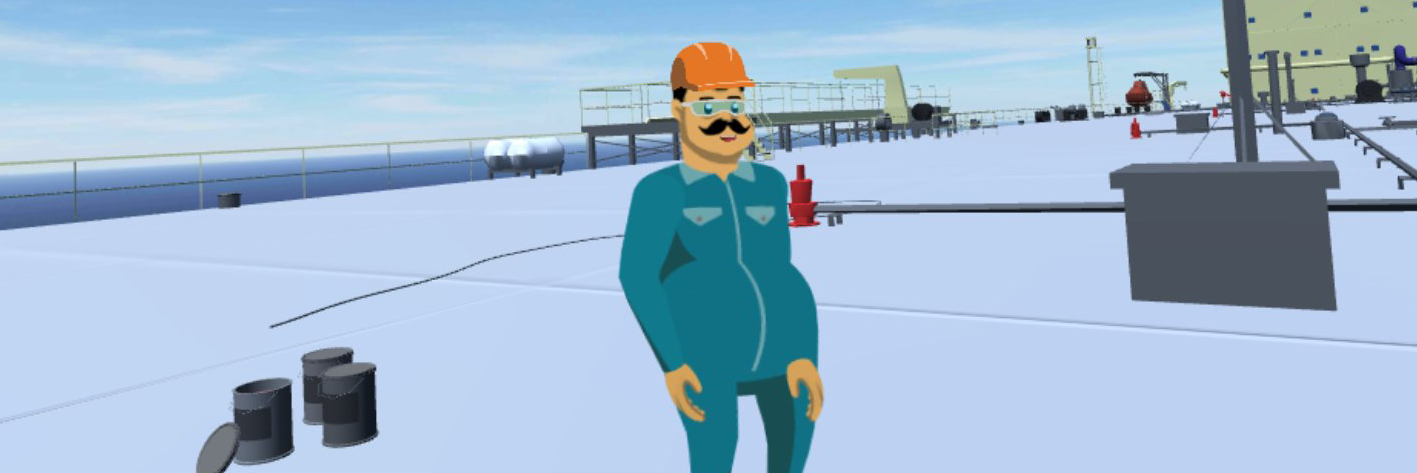 Source: Virsabi
Process skills are complex skills including knowledge on setting machines, handling remote tools such as Computer tomographs, controlling systems in an atomic power plants or managing cargos in a huge ship. It includes awareness of health and safety rules. Good examples include chemistry lab protocols, product lines management or even working with disabled people to reteach skills for everyday life.
An example in onboarding in IKEA.
IKEA saw a great opportunity in releasing a VR-experience at their Talent Focus Week in March 2018. Even though the VR-experience aimed at educating co-workers during the Talent Focus Week, it is also meant to be used for introducing what it’s like to work at IKEA.
The VR-experience was delivered in 18 different languages. It met cultural differences and different learning methods and at the same time, it sought to unite the co-workers to feel as a part of a big global family that is keen on helping each co-worker in reaching the next level.
The objective of the VR-experience was to enable co-workers to experience one of the many IKEA environments in IKEA’s value chain and experience a leadership role. One aspect of being a good leader at IKEA is how you practice leadership inspired by IKEA’s 8 key values. Examples of some of the key values are; “Togetherness” & “Simplicity”. The experience was so well received that an improved VR solution was used in 2019. Source: Virsabi
Using 3D Avatars
Healtcare and medicine probably the most adequate areas where avatars may step in. Difficult operations (adroit fingers manipulating with catheters in veins for example) can be learned using virtual mannequins and other haptic devices. Emergency situations what are risky or impossible to simulate with real people and subjects can be substituted with VR simulations at a relatively low cost. Military combat training are supported with trainings with virtual avatars. There are situations, when only virtual avatars are eligible. Other cases such as reanimation need real dummies to give real feel of pressure or other haptic effect.
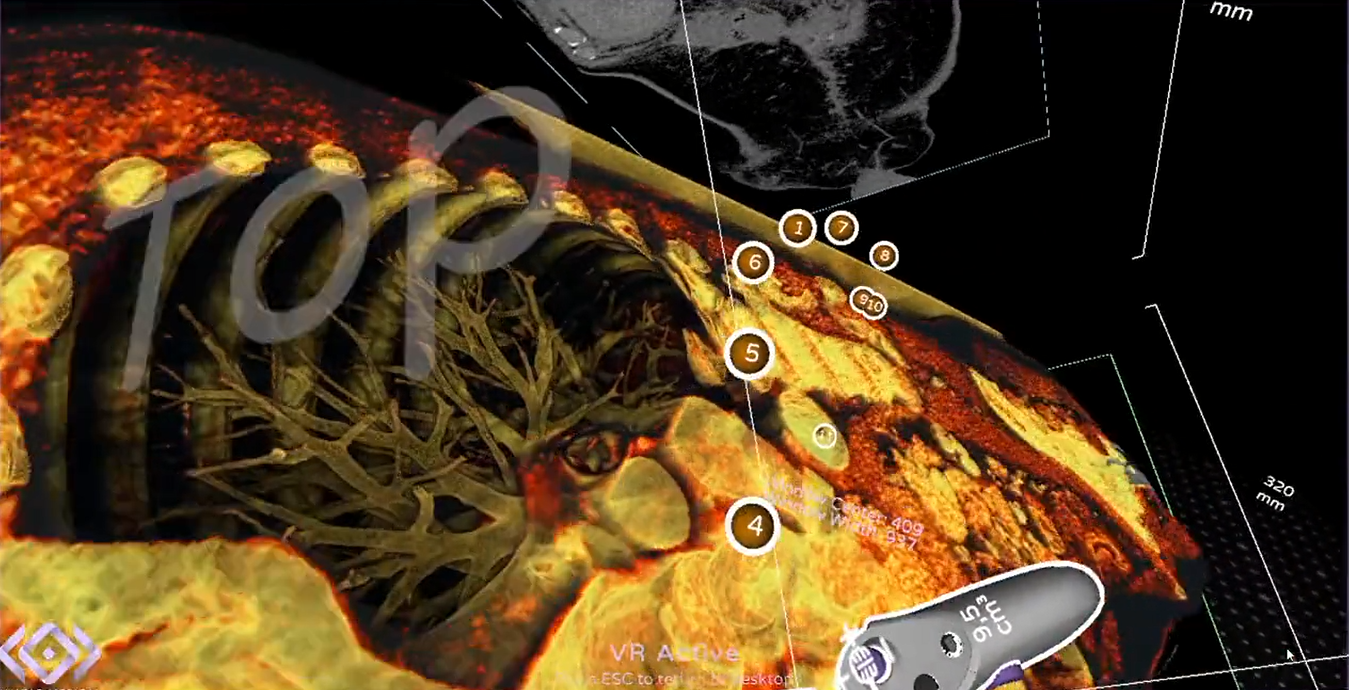 photo courtesy of avatarmedical.ai
Example: avatar based education using Second Life
"A plane crashes into a chemical plant. Scattered amid the smoking wreckage lie the bodies of the dead and wounded. Nurse-in-training Adam Nelson approaches each survivor. But instead of speaking to the victims, Nelson clicks on their images. A text box appears on Nelson’s computer screen, listing each patient’s symptoms. Nelson is learning “triage” skills through a Second Life disaster simulation, part of the University of Wisconsin at Oshkosh’s online bachelor’s in nursing degree program. Second Life is a virtual world where users interact in real time with each other, using three-dimensional versions of themselves, called avatars. Nursing schools in the United States are increasingly incorporating virtual learning into their online healthcare degree programs using systems like Second Life, a virtual reality metaverse. Some programs use virtual reality to stage scenarios that would be too costly or too difficult to create in real life. University of Wisconsin Oshkosh’s use of Second Life to simulate an online nursing disaster drill is a great example employing virtual reality for training purposes. Other programs use virtual reality systems to create virtual patient labs or to mimic classroom discussions." (Source: https://www.geteducated.com/healthcare-a-nursing/339-online-nursing-degree-programs-teach-using-second-life-virtual-simulation)
Safety and emergency
As we already mentioned above in process skills the importance of protocols to avoid situation that never should happen. One direction in safety and emergency is prevention. Training for the prevention of risks and to learn about safety measures can be well implemented with VR learning scenarios. The topic is related to other scenarios and almost all serious simulations integrate prevention trainings. An example is routine safety checks are mandatory and cannot be skipped in driving examinations in vehicles. The other direction is emergency protocols. In these simulations train the learners how to act when accidents happen.
Example: ship safety
VR Safety is the name of the virtual reality safety training tool Virsabi built for two Danish maritime educational institutions. The tool lets the students experience safety situations and train their knowledge aboard a ship before actually setting sail. In VR Safety, the student meets for instance an animated mentor who takes the student through safety training aboard a ship. Speech, facial expressions, and body language are all used for information, instructions, and praise after correctly performed exercises. The student then must identify correct and incorrect behavior performed by the characters.
Source: https://virsabi.com/simac/
Professional Competencies
Professional competencies scenarios focus on group of skills required for a specific profession. They may cover a few profession groups such as 'drivers', or focus on specific fields such as social workers for disabled people. The learning scenarios may fully or partly include other scenarios such as process skills or safety scenarios. These scenarios are mostly customised solutions developed for a specific client group.
Communication skills
Certain communication skills such as protocols, or language basics can be improved by VR/AR learning scenarios. Training situations are developed to conflict resolutions in virtual spaces with avatars instead of real person trainings. Other learning scenarios focus on phobias such as fear of public speaking or sense of height. Some scenarios are designed to act from a certain positions, others simulation makes possible to walk around in the space of a building or territory.
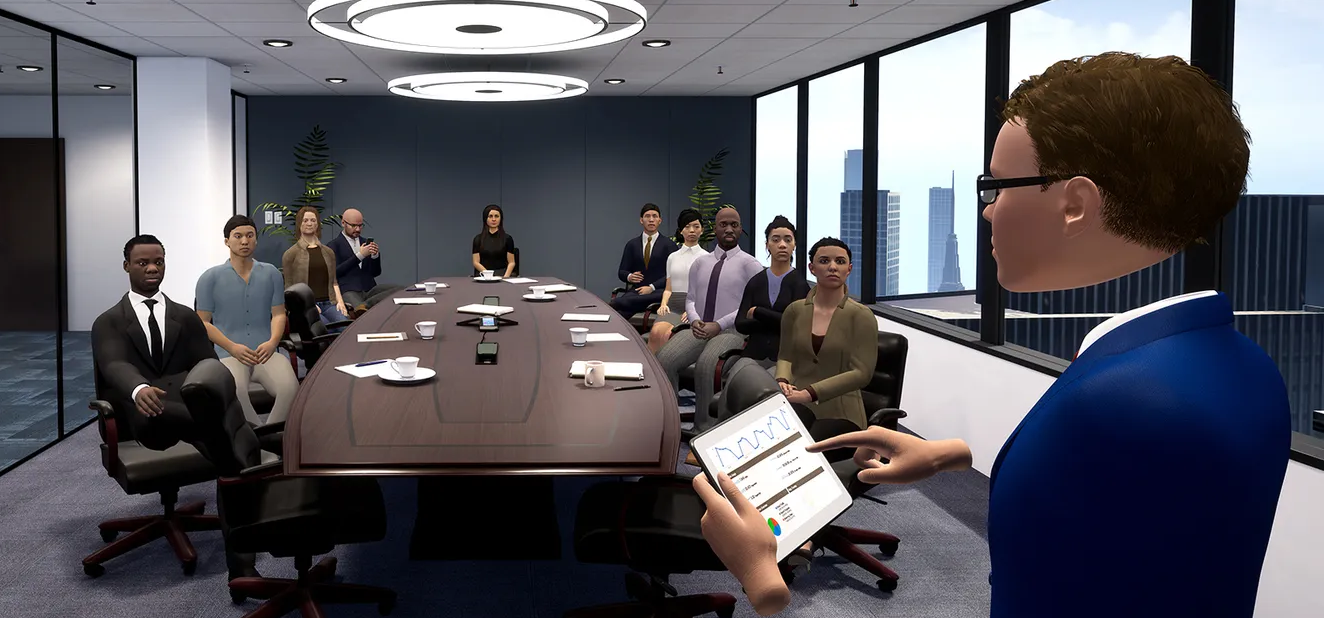 Source: VRSpeaking
Examples in the corporate world
Workplace communication can be a learning objective in the corporate world. The pressures of having a customer react emotionally to a situation can leave employees questioning how to respond. Many people do not have the skills of remaining calm under pressure, diffusing situations, or active listening. Being able to find a solution is a skill that can be improved with VR. Employees can practice engaging with difficult clients through a VR headset or laptop and role play scenarios.
Other area is public speaking. With VR simulations, employees can face their fears without judgment. Different simulators put you in a situation where you’ll present to an office or crowd of people. You can adjust the settings to where the audience reacts based on the performance the employee gives.
Source: https://www.belithe.com/how-to-improve-communication-skills-with-vr-a-guide/
STEM learning
Simulation has a boosting chance to propagate in the Science, technology, engineering and mathematics (STEM) field. Nature, physics, computer technology and other technical subjects are worth to be gamified, because offers an entertaining alternative to learning of formulae and definitions that put many young off. We show examples of learning general scientific subjects such as in chapter Mixed reality with Microsoft Hololens.
Analysis platforms - the keys to personal improvement
Some of the examples above contain LMS platforms providing trainers and students a learning environment. It is designed as a responsive easy-to-use interface which allows users to access their material and exercises on different mobile devices. Currently, VR content is embedded within the curriculum of a learning station as information with task descriptions and instructions how to use the VR application. Results of the VR can be manually transferred back to the LMS by trainers or students to document the learner progress. These platform have VR scenarios that allows to switch easily from the LMS to VR tasks and storing results back to the LMS automatically. Thus, progress of the students could be saved and mapped to their competencies in a fine-granular manner. Then all results of the learning station could be used in overall reports and statistics to support students in improving their skills. Additionally, a comprehensive collection of these data empowers trainers to adapt their lesson plans based on the strengths and weaknesses of their class.
In welding there are solutions that immediately detect learners' weaknesses and tailor training to each individual. The analysis platform accurately analyzes the performance of the students during the execution of an exercise in real time. It also provides the teacher with all the information she or he needs to increase efficiency and flexibility. These applications are standalone softwares that
- can connect to a Learning Management System and to all other immersive training solutions
- has simplified access via a CLOUD platform and centralization of information
- shows detailed performance data for each of your learners over time
- is able to customize the training courses for each student.